There Is Always an &
Dawn LaRochelle, Executive Director


January 15, 2026 | Third Thursday Thoughts
Dawn LaRochelle, Executive Director
I come from a family of singers.
My older brother can sit down at a piano and croon Stevie Wonder or Billy Joel with the control and polish of a professional vocalist — not as a performance, just as a baseline. My younger sister is the lead singer in an Iron Maiden tribute band (yes, really). Even my dad had a beautiful baritone, which he mostly used to belt out God-knows-what in the shower, door closed, steam rising, fully committed.
Me? Let’s just say Broadway was never going to come calling.
My voice is fine. Pleasant, even. But my range is painfully limited. Anything more than a few notes in either direction and things start to feel… aspirational. Picture an elevator where several floors simply don’t exist.
Case in point: Simon & Garfunkel. One of my faves, because I’m old like that. I’ll be in my Mini Cooper, singing along to The Sound of Silence, playing some serious seat belt guitar, riding those lyrics right up to the edge… and then suddenly, my throat files a formal complaint.
As a teenager, this failing felt devastating. I loved the theater. I loved being on stage. I desperately wanted to be in musicals, but my voice simply wasn’t built for that world. I learned early how to smile through auditions, how to pretend disappointment didn’t linger (I did, however, play the Cheshire Cat in Alice in Wonderland and absolutely brought down the house with my Cheshire Cat grin. So, there’s that.).
What I didn’t understand then was that voices are situational.
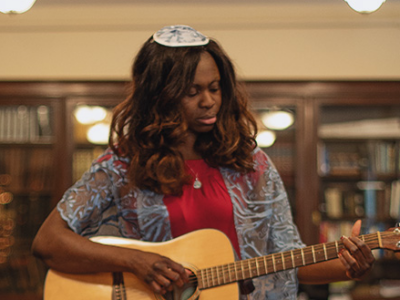
I learned that lesson many years later, standing on the bimah at my oldest son Scott’s bar mitzvah. When I was called to the Torah, I sang the blessings for the aliyah, the Shehecheyanu, and Baruch she-petarani. Not because I volunteered, but because I was expected to. Jewish tradition assumes readiness. It extends trust before confidence has a chance to catch up.
There was no warm-up and no experimenting. Just the expectation that I would rise to meet the moment.
The room went still in that particular synagogue way. Not hushed, not dramatic, just fully present. Later, Sisterhood members pulled me aside, as if this were already settled, and demanded to know why I wasn’t in the shul chorus.
It wasn’t about being “good.” It was about being claimed. By the simcha, the music, the space.
I didn’t find my voice by choosing it. I found it because someone trusted me with it.
I think about that a lot at the Maine Jewish Museum.
Because the moments that linger — the grounding ones, the connective ones, the quietly transcendent ones — don’t happen on autopilot. They happen because someone extends an invitation. Because space is held. Because trust is offered before certainty.
You can feel that ethos throughout the Museum right now, in the programs we host, the conversations we convene, and on the walls of our galleries (and speaking of our gallery walls, check out this amazing review of one of our current exhibitions, Printscaping, in yesterday’s Portland Press Herald — proud, much?!).
Which brings me to the ask. Because creating spaces like this — for art, music, history, and belonging — costs money. Real money. Heating-the-building, paying-artists, keeping-the-lights-on money.
And while this may come as a surprise, our Annual Appeal does not end when the calendar flips to January. It runs through the end of February.
I know this is the part where many of you say, “Well, there goes the tax deduction.” Fair enough. But the work doesn’t reset just because the paperwork does.
If you’ve already made a gift, thank you. Truly. You are part of this story.
If you meant to give and December got away from you, this is your moment to step in.
And if you’re wondering whether a January or February donation still matters, the answer is yes. Emphatically so.
Your support keeps MJM a place where people don’t have to audition for belonging.
Where all voices are welcome.
Where you can show up with a limited range, a complicated story, and a few missing elevator floors, and still be part of the harmony.
Because this place isn’t built for people with perfect pitch.
It’s built for people willing to show up and sing anyway.
Warmly,
Dawn
P.S. Thanks to an extraordinary commitment from MJM Board President Bob Hirshon and the Wein-Hirshon Foundation, a $25,000 Matching Grant for all first-time donors and for anyone who increases their support this year, making your contribution doubly impactful. To confirm what you gave last year, contact us at or 207-773-2339.
Dawn LaRochelle, Executive Director


All images copyright of the artist, unless otherwise noted; reproduction not allowed without express permission
Website by WEBFIX STUDIO.